Drawing is the practice of using lines, shapes, values, and other marks to represent what an artist sees or imagines. Improving it does not require expensive classes: consistent observation, focused exercises, and feedback from free or low-cost resources can build practical skills over time. A 2023 study published in Psychological Science found that people who practiced a visual task for 20 minutes a day over several weeks improved their performance, supporting the value of regular, deliberate practice. The sections below explain how to structure that practice, learn from observation and reference, use affordable feedback, and track progress without mistaking tools or talent for the main drivers of improvement.
Deliberate Practice Improves Drawing Skills
Deliberate practice means working on a specific skill with a clear goal, sustained attention, and opportunities to correct mistakes. Psychologist K. Anders Ericsson and colleagues described this approach as focused practice designed to improve performance, rather than simply repeating an activity. In drawing, that means choosing a concrete target—such as more accurate proportions—instead of drawing casually and hoping every session produces progress.
Drawing skill includes several related abilities: seeing shapes accurately, constructing forms in space, controlling line and tone, and communicating a subject clearly. These abilities overlap, but practicing them separately can make weaknesses easier to identify. A sketchbook, pencil, and a short routine are enough to begin.
Focused Exercises Build Specific Skills
A focused exercise isolates one challenge for a limited period. For example, draw a mug from observation while concentrating only on its overall proportions; then repeat the drawing while checking the angle of its ellipse. This makes it easier to notice what changed and what still needs attention.
Try a simple 30-minute session: spend five minutes warming up with lines and ellipses, 15 minutes on one targeted exercise, and 10 minutes reviewing the result. Useful targets include contour, perspective, value, gesture, or negative space. Change one variable at a time so you can tell whether a new approach is helping.
Short, Regular Practice Supports Retention
Regular practice creates more chances to notice errors and apply corrections than occasional marathon sessions. A 2023 study in Psychological Science reported improvement after participants practiced a visual task for 20 minutes daily over several weeks. The study focused on visual learning rather than drawing specifically, so it should not be read as a guaranteed formula for artistic progress. It does, however, support the broader idea that brief, repeated practice can strengthen visual skills.
Choose a schedule you can sustain, such as 20 minutes on five days each week. Record the date and the skill practiced. If you miss a day, resume with the next planned session instead of trying to compensate with an exhausting practice block.
Observation and Reference Improve Drawing Accuracy
Observation is the deliberate study of a subject’s proportions, angles, edges, light, and spatial relationships. Drawing from life or from a reference helps train artists to compare what they see with what they put on the page. It also counters familiar visual symbols—such as drawing every eye or tree in the same simplified way—by directing attention back to the particular subject.
Drawing from Life Trains Visual Comparison
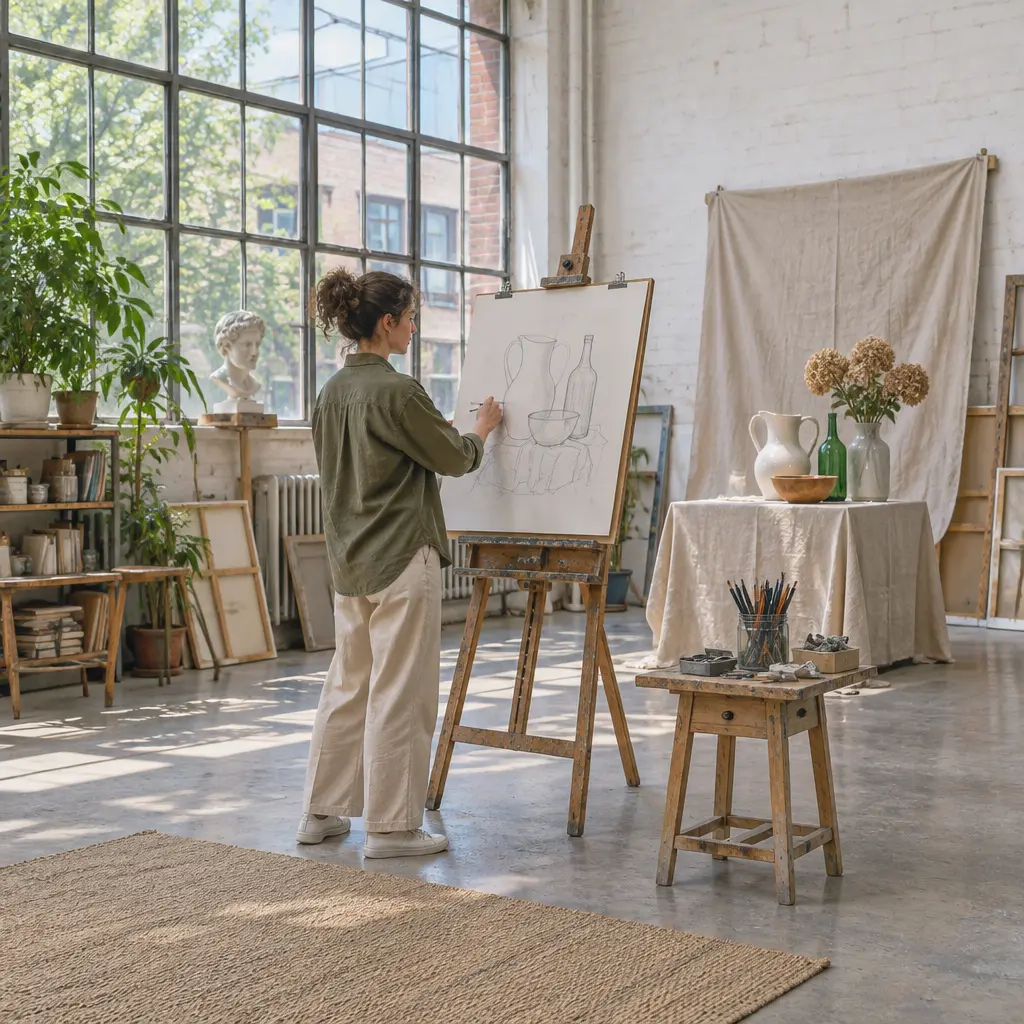
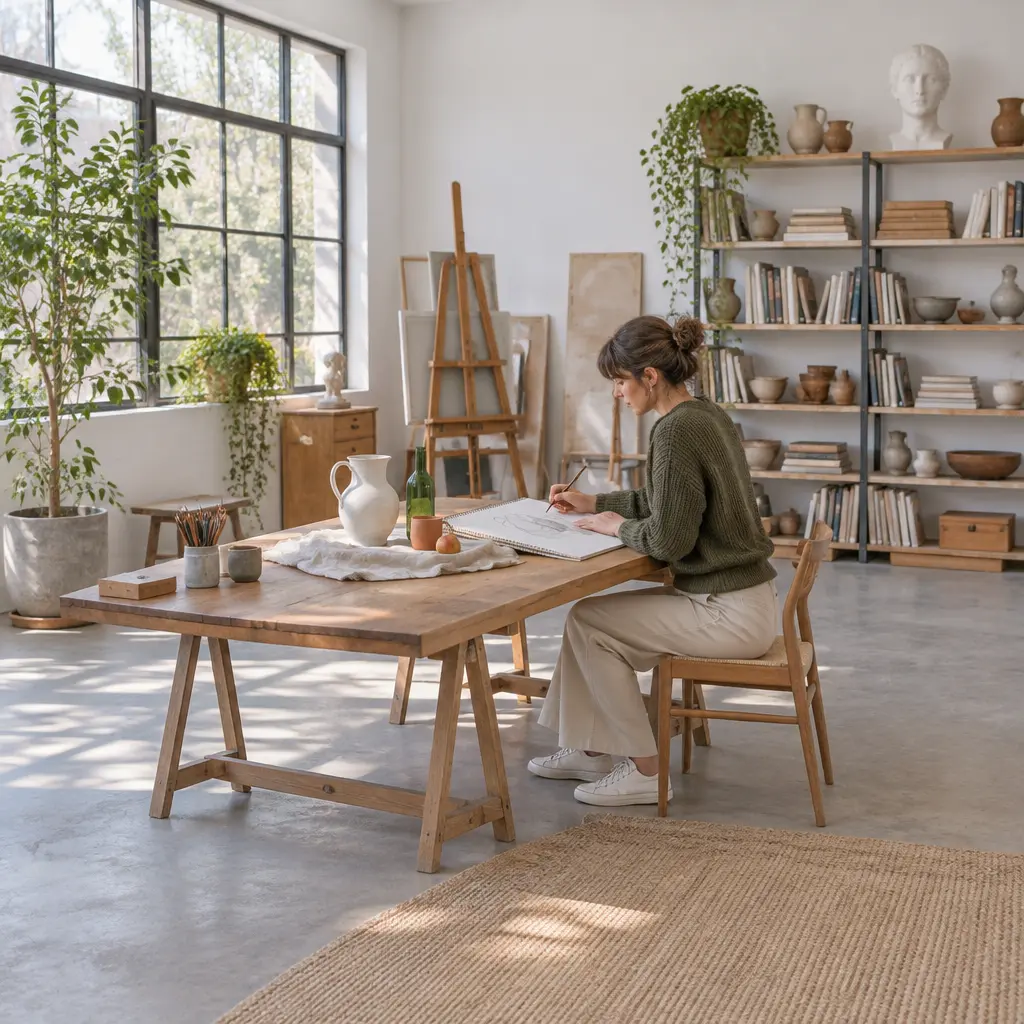
A still life made from household objects is a free way to practice. Arrange three objects, such as a cup, fruit, and a box, then compare their relative heights and widths before adding detail. Check the angles of major edges, the gaps between objects, and the shapes of the empty spaces around them. These comparisons are often more useful early in a drawing than rendering small details.
For a practical accuracy check, use a pencil held at arm’s length to compare apparent angles or relative lengths. This is not a precision measuring instrument; it is a way to make visual comparisons more systematic. Step back periodically, since a drawing that looks convincing up close can appear uneven from across the room.
Reference Images Extend Practice Options
Reference images provide subjects that may be difficult to arrange or observe in person, including wildlife, architecture, and dynamic poses. Use images you created yourself or sources that clearly permit reuse, and avoid presenting a close copy of another artist’s work as an original design. The U.S. Copyright Office explains that copyright protects original works of authorship, including visual art; studying a reference and publishing a derivative image are not necessarily the same use.
When using a photograph, first identify its largest shapes and light-dark pattern. Then compare the drawing with the reference at regular intervals. For personal study, it can also help to draw the same subject from two different references, which encourages understanding of form rather than memorizing one image.
Gesture and Contour Develop Different Kinds of Seeing
Gesture drawing captures a subject’s overall action, direction, and weight in a quick, simplified drawing. Contour drawing, by contrast, concentrates on visible edges and shape boundaries. These are complementary exercises: gesture supports lively structure, while contour practice encourages careful attention to form.
For gesture, set a timer for one or two minutes per pose and use long, economical marks to show the main movement. For contour, spend five to ten minutes drawing a simple object slowly, checking how its edges turn and overlap. Free pose-reference sites, public library art books, and objects at home can all provide subjects.
Low-Cost Feedback and Learning Resources Support Progress
Feedback is information that helps a learner compare a result with a goal and decide what to adjust. It need not come from a paid instructor. A self-review checklist, a moderated online art community, a peer drawing group, or a free tutorial can all provide useful input when the advice is specific and relevant to the skill being practiced.
Self-Critique Turns Errors into Next Steps
Self-critique is a structured review of a drawing against a small set of criteria. After finishing a study, ask three questions: What reads clearly? What looks inaccurate? What one change would improve the next attempt? This keeps review constructive and prevents a vague judgment such as “I am bad at drawing” from replacing a useful diagnosis.
Keep earlier drawings rather than discarding them. Compare work from the same exercise every two to four weeks, looking for changes in proportion, confidence, or value control. A dated progress folder provides evidence of development that can be hard to notice from one session to the next.
Free Tutorials and Communities Offer Accessible Guidance
Free video lessons, museum collections, library books, and artist communities can explain techniques without tuition costs. The Smithsonian American Art Museum and other public institutions provide online access to artworks that can be studied for composition, mark-making, and subject treatment. Online communities can add critique, but learners should request feedback on a specific question—such as whether a head’s proportions feel balanced—instead of asking only whether a drawing is good.
Evaluate advice by checking whether it explains a principle and offers a way to test it. A tutorial that demonstrates how to compare angles is more actionable than one that promises a shortcut. Try one suggestion at a time, since combining several unfamiliar methods can make it difficult to identify what works for you.
A Basic Materials Kit Is Enough to Start
Drawing materials affect convenience and marks, but expensive supplies are not prerequisites for learning. A graphite pencil, an eraser, and inexpensive paper can support studies in line, shape, and value. The National Arts Education Public Awareness Campaign has emphasized the role of arts learning in education; its advocacy is not evidence that a particular art supply improves drawing, so material choices are best judged by function and affordability.
Buy supplies only when a practice need becomes clear. For example, a softer pencil may help with darker values, while a ruler can support perspective exercises. Use what you already have first, and spend more only if a tool solves a recurring problem.
Progress Tracking Makes Practice More Useful
Progress tracking means recording practice and reviewing outcomes against a goal. It helps distinguish effort from effective practice: time spent drawing matters, but so does whether the exercise addresses a specific skill and whether the learner applies what they discover.
A Practice Log Reveals Patterns
A simple log can include the date, exercise, duration, difficulty, and one observation. For example: “Tuesday, 20 minutes, boxes in two-point perspective; vertical edges drifted; next time, check convergence before shading.” Over several weeks, the log can show which exercises are repeated, where frustrations recur, and which corrections produce clearer results.
Track process measures you control, such as sessions completed or studies attempted, alongside outcome measures such as proportion accuracy. Avoid using social-media likes as the main measure of skill: popularity is influenced by subject, presentation, and audience, not just drawing quality.
Milestones Keep Goals Manageable
A milestone is a specific, observable target that marks progress toward a broader goal. Instead of “become good at drawing,” choose “draw a recognizable household object using three values” or “complete five one-minute gesture studies.” Small milestones make it easier to select exercises and decide when to increase difficulty.
A useful cycle is to choose one skill, practice it for two weeks, review a sample of the drawings, and set the next target. If progress stalls, simplify the task or seek targeted feedback rather than assuming that you need more expensive equipment or a full course.
Conclusion: Improve Drawing Through Consistent, Affordable Practice
Drawing improves through deliberate practice, careful observation, useful reference, feedback, and reflection—not through expensive classes alone. Focused exercises develop specific skills; life drawing and reference strengthen visual comparison; low-cost resources and self-critique offer guidance; and a practice log makes change easier to see. Start with a pencil, a simple subject, and a manageable schedule. Choose one skill to practice this week, keep the drawings, and review them after several sessions. For further study, explore free museum collections, public library art resources, and reputable drawing demonstrations.
Sources: Ericsson, K. Anders, Ralf T. Krampe, and Clemens Tesch-Römer, “The Role of Deliberate Practice in the Acquisition of Expert Performance,” Psychological Review, 1993, https://doi.org/10.1037/0033-295X.100.3.363; Psychological Science, 2023 study on daily visual-task practice, https://journals.sagepub.com/home/pss; U.S. Copyright Office, Copyright Basics, https://www.copyright.gov/circs/circ01.pdf; Smithsonian American Art Museum, Online Collection, https://americanart.si.edu/collections/search; National Arts Education Public Awareness Campaign, Arts Education and Student Achievement, https://www.arteducators.org/advocacy-policy/arts-education-public-awareness-campaign.