Digital painting in narrative illustration is the creation of story-focused images with digital tools, combining visual storytelling, sequential composition, and techniques such as layers, brushes, and color grading. Its direction is not simply toward faster software: it is toward more connected workflows in which artists use digital tools for research, iteration, animation, and collaboration while retaining human control of narrative and style. The shift matters in a global art market valued at about $65 billion in 2023, according to Grand View Research, though that figure covers the broader visual-art market rather than digital narrative illustration specifically. The following sections examine how digital painting serves story, how new workflows are changing production, what generative AI means for illustrators, and which skills and ethical choices are likely to matter most.
Digital Painting’s Narrative Function
Digital painting is a method of making and revising images on digital devices, but narrative illustration is distinguished by what the images communicate: character, setting, action, mood, and change. The Society of Illustrators describes illustration in relation to visual communication and interpretation; in narrative practice, an image is therefore not only attractive but also helps an audience infer what has happened or what may happen next. Digital painting’s defining attributes include editable layers, adjustable color, reusable assets, and the ability to revise compositions without rebuilding every mark by hand.
These attributes connect to several forms of story illustration: single-image narrative art, picture-book illustration, comics and graphic novels, concept art, and illustrated game or screen development. Each uses images differently, but all depend on visual choices that direct attention and establish meaning. A useful way to understand digital painting’s future is to begin with these storytelling functions, then consider how production tools are expanding them.
Composition and Visual Sequence
Composition is the organization of shapes, figures, light, and empty space within an image. In narrative illustration, it guides the viewer through the scene: a character’s gesture can point toward a clue, a strong diagonal can imply movement, and a change in scale can signal danger or intimacy. In a comic or picture book, the same principles extend across panels or pages, where framing and sequence shape the reader’s sense of time.
Digital canvases make it easier to test these decisions. Artists can create thumbnails, compare alternative crops, and adjust foreground or background elements on separate layers. The practical benefit is not that software supplies a good composition automatically, but that revision becomes cheaper and quicker. Artists can spend more time evaluating whether each image advances the story.
Color, Light, and Emotional Continuity
Color scripting is the planning of color and lighting across a sequence to establish mood and maintain continuity. Digital painting supports this through editable adjustment layers, palette studies, and non-destructive color changes. A warm palette may make a setting feel welcoming, while a later shift toward cooler or less saturated colors can communicate estrangement or loss without additional dialogue.
For a series, visual consistency is also a production concern. Reusable palettes, reference boards, and shared files help teams keep a character’s appearance and a location’s lighting coherent across multiple illustrations. These methods link the expressive role of color to the practical demands of collaborative work.
Digital Painting Workflows and Production
A digital painting workflow is the ordered process used to move from a story brief to finished artwork. It commonly includes research, thumbnails, composition, drawing, value and color studies, rendering, review, and delivery. There is no single authoritative definition shared by every studio; publishers, game teams, and independent artists adapt the stages to their formats and deadlines. What they share is iterative decision-making: the image is developed and checked against a narrative purpose rather than treated as a single uninterrupted act of rendering.
The workflow’s major branches—tablet-based painting, 3D-assisted illustration, asset libraries, and cloud collaboration—are changing how artists test and deliver ideas. Their value is clearest when considered as ways to support storytelling rather than as ends in themselves.
Tablet Painting and Rapid Iteration
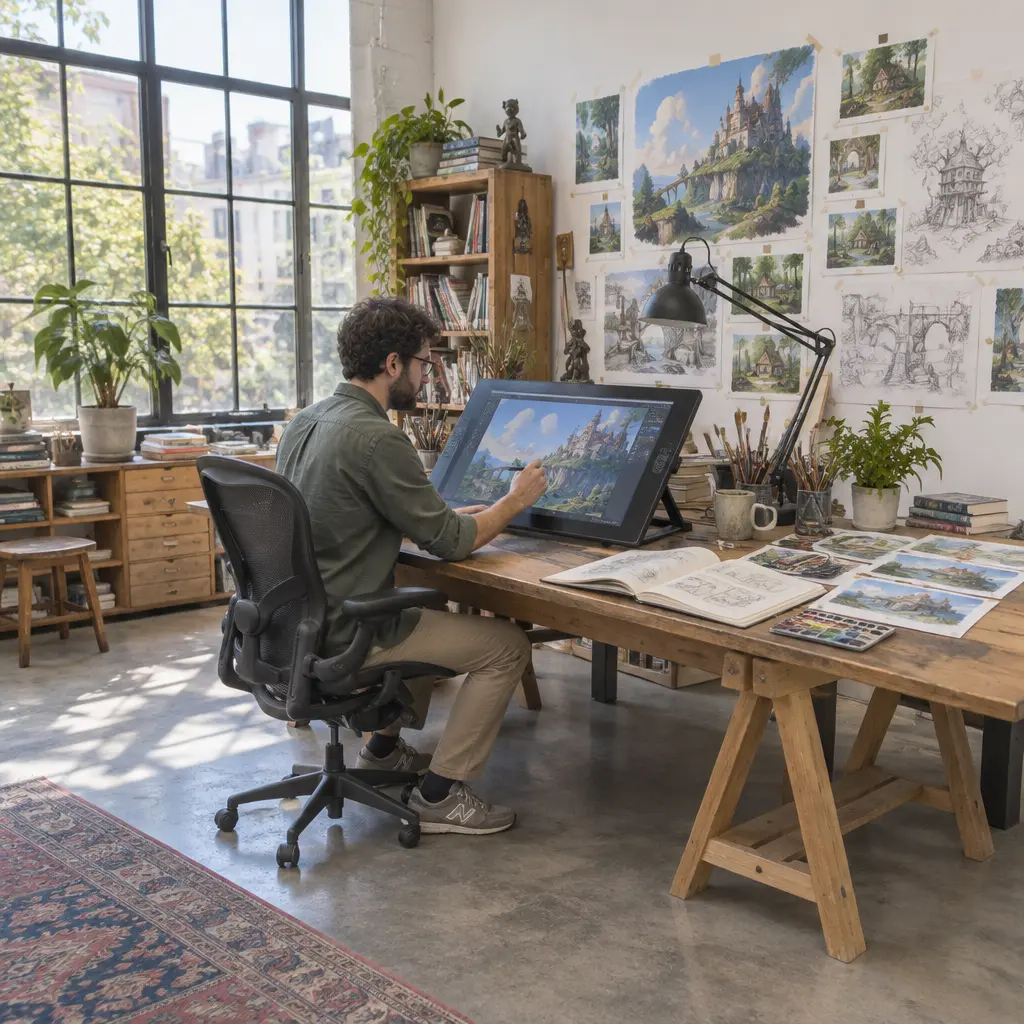
Tablet painting uses a pressure-sensitive stylus and digital canvas to approximate or extend drawing and painting practices. Software such as Adobe Photoshop, Clip Studio Paint, and Procreate supports layers, masks, brushes, and transformations. Artists can keep rough sketches separate from finished colors, preserve alternate versions, and make localized changes without repainting an entire image.
That flexibility is especially useful during art direction. A publisher may request a different expression, a clearer silhouette, or a revised focal point after reviewing a draft. Digital revision can make such changes more manageable, although it does not eliminate the time needed for careful drawing, visual research, or feedback.
3D Reference and Hybrid Illustration
Hybrid illustration combines hand-painted imagery with other digital methods, including 3D models, photography, and procedural textures. A 3D blockout can help an artist check perspective, camera angle, or complex architecture before painting over it. The finished image can still be painterly and individually authored: the model functions as a reference or structural aid, not necessarily as the final visual style.
This approach is useful in recurring settings, elaborate environments, and scenes with difficult perspective. Its limitation is that technical accuracy alone does not create a compelling image. Artists still need to decide what to simplify, emphasize, or distort so that the scene reads clearly and supports the intended emotion.
Collaboration, Versioning, and Delivery
Collaborative digital production allows writers, editors, art directors, and illustrators to exchange drafts and comments through shared systems. File naming, version control, color profiles, and delivery specifications are less visible than brushwork, but they help prevent conflicting edits and ensure artwork works in print or on screens. In a multi-artist project, visual guides can also document character proportions, costume details, and location palettes.
The wider creative economy helps explain why these production skills matter, but broad market figures should be interpreted carefully. Grand View Research estimated the global art market at roughly $65 billion in 2023; that category is far larger than digital illustration and does not measure illustrator employment, commissions, or earnings. It indicates the scale of the surrounding art economy, not a guaranteed market for any particular digital technique.
Generative AI and the Future of Narrative Illustration
Generative AI refers to systems that produce text, images, or other outputs from learned patterns and user instructions. In illustration, these systems may assist with brainstorming, reference exploration, or rough visual options. They also raise questions about training-data consent, attribution, copyright, and the economic position of working artists. The U.S. Copyright Office’s 2023 guidance states that copyright protection depends on human authorship and that prompts alone may not provide sufficient human control over the expressive elements of an AI-generated image.
The most consequential distinction is between using a tool to support an artist’s decisions and treating generated output as a substitute for accountable authorship. This distinction leads from experimentation to questions of craft, rights, and professional practice.
AI as a Reference and Ideation Tool
As an ideation tool, AI may help generate prompts, compare broad mood directions, or explore visual references. Artists can also use non-generative tools—such as search databases, 3D scenes, and their own photo references—for similar early-stage purposes. Any reference must be evaluated for accuracy, originality, and fit with the story; a plausible-looking image may contain historical, cultural, or anatomical errors.
For narrative work, the artist’s selection and revision remain central. A scene must communicate specific character relationships and story information, not merely resemble a requested style or subject. Human review is therefore a creative and factual safeguard, not just a final polish step.
Authorship, Copyright, and Consent
Authorship concerns who made the expressive choices in an image, while copyright concerns legal rights in the resulting work. The Copyright Office’s report on copyrightability of AI-generated material emphasizes that protection can apply to human-authored contributions, such as sufficiently creative selection, arrangement, or modification, but not automatically to material generated without adequate human authorship. Legal rules and litigation continue to evolve, so artists and publishers should check current guidance and contract terms rather than assume one universal rule.
Consent is a separate but connected issue: artists may object to their work being used to train a model without permission or compensation. Clear disclosure about tools, licensing, and source material can help clients make informed decisions and protect working relationships. This makes ethical process part of professional craft.
Human Judgment as a Creative Advantage
Narrative illustration depends on judgment that is difficult to reduce to image generation: deciding which moment best reveals a character, how much information to withhold, and when visual ambiguity is meaningful. Artists also bring lived experience and cultural understanding that affect how characters and communities are represented. These capacities will remain important even as production tools change.
The practical future is likely to be mixed rather than purely manual or fully automated. Artists can adopt tools that demonstrably improve a workflow while documenting their use, protecting original files, and retaining control over final narrative choices.
Skills and Directions for Artists
The future-ready narrative illustrator combines traditional visual foundations with digital fluency. Drawing, perspective, value structure, color, anatomy, and visual research remain essential; file management, collaboration, and responsible use of new tools add practical resilience. The strongest preparation is not mastery of every application but the ability to choose a method that serves a particular story and production context.
Build a Story-Centered Portfolio
A story-centered portfolio demonstrates more than polished single images. It can show character expressions, sequential scenes, environment studies, and a clear range of moods, alongside a brief explanation of the narrative challenge each piece addresses. Showing sketches or color studies can also make the artist’s reasoning and revision skills visible to editors and clients.
Learn Adaptable Digital Fundamentals
Adaptable fundamentals include working with layers and masks, exporting files correctly, maintaining backups, and using reference responsibly. Artists should also understand the difference between raster and vector artwork, RGB and CMYK color workflows, and image resolution requirements. These basics support work across picture books, comics, editorial illustration, games, and other formats.
Make Ethical Practice Visible
Ethical practice includes accurately describing how images were made, respecting licensing restrictions, and avoiding misleading claims about references or AI involvement. Studios and clients can help by setting clear policies for generated material, attribution, confidentiality, and file retention. Artists can ask these questions before work begins, when expectations are easiest to document.
Conclusion: A More Connected, Human-Led Practice
Digital painting’s future in narrative illustration is shaped by three connected developments: its continuing role in composition and emotional storytelling, increasingly flexible workflows that combine painting with 3D and collaboration, and the arrival of generative AI alongside unresolved questions of authorship and consent. Digital tools make iteration and production more adaptable, but they do not replace the visual judgment that gives an image narrative meaning.
Artists, educators, and publishers can respond by strengthening foundational skills, experimenting critically with new workflows, and establishing transparent standards for rights and disclosure. For further reading, consult the U.S. Copyright Office’s guidance on AI and copyright, study professional illustration portfolios and process notes, and test new tools on small projects before incorporating them into client work.
Sources: Grand View Research, Art Market Size, Share & Trends Analysis Report, https://www.grandviewresearch.com/industry-analysis/art-market-report; Society of Illustrators, About the Society of Illustrators, https://societyillustrators.org/about/; U.S. Copyright Office, Copyright Registration Guidance: Works Containing Material Generated by Artificial Intelligence, 2023, https://www.copyright.gov/ai/; U.S. Copyright Office, Copyright and Artificial Intelligence, Part 2: Copyrightability, 2025, https://www.copyright.gov/ai/.